Weekend in Syunik or new adventures in Syunik province part II
You open the door, cross the threshold of the house, and find yourself in a magical world. You reach out your hand and can touch the figures rising in the forest. They are here, right in front of you in the embrace of native nature.

ԲԱՑԱՀԱՅՏԻ՛Ր
ՕՐ ԱՌԱՋԻՆ
Tandzaver
Tel. +374 93 94 19 06 Mikael Shelemetev, Bagrat Hakobyan
FB: @tandzavervillage
For your next trip, you leave everything behind and head to Syunik. This time, from Tatev you take the road toward Kapan. As soon as you see the sign for Tandzaver village, you turn left. In the forest of this village, you can encounter unique wooden sculptures created not only by Armenian artists but also by artists invited from abroad.
You can also engage in creative activity in the forest—once you enter, you are gifted with a kind of supernatural energy. If you are far from art, kilometers away, that belongs to the past. Try it.
Here, there is also a developed tourist trail leading to Vanand Fortress, whose beauty you can enjoy by hiking or cycling. In fact, Tandzaver can be considered a complete destination for upcoming free days. In addition to land art, you can enrich your trip with various hiking and cycling routes, horse riding, and the village’s small, neat guesthouses will be happy to host you.
Khndzoresk Revival Foundation
Tel. +374 43 00 44 22, +374 94 44 22 89 Anahit Aleksanyan
FB: minahotelingoris
We move on to Khndzoresk. The journey is intense—believe me, you won’t regret a single minute.
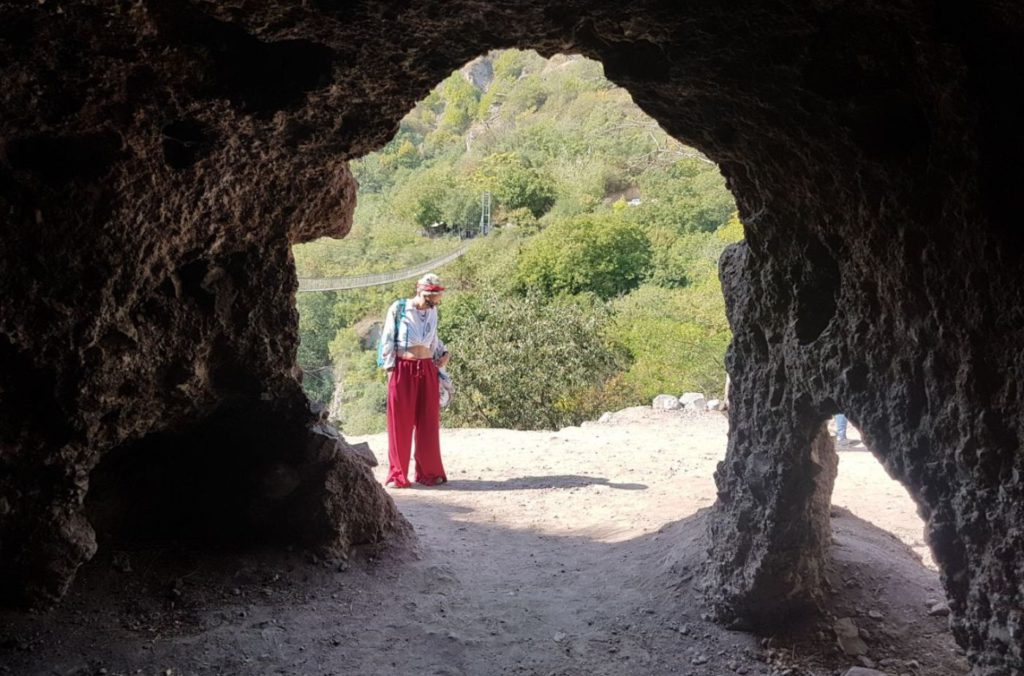
Excitement, admiration, fear, surprise—the feelings of people on the “Swinging” bridge are diverse and never repeat. Built in just a few months, the bridge is 160 meters long and 63 meters high.
Today, the bridge is known among tourists as the Khndzoresk “Swinging Bridge,” connecting two parts of the village—from Old Khndzoresk to the tomb of Mkhitar Sparapet. Preserving the historical atmosphere of the village and the purity of nature, it makes visits to Syunik even more attractive.
The author of the “Swinging Bridge” is Uncle Zhora, who dedicated the structure to the memory of his parents. Uncle Zhora likes to sit on the chair next to the bridge. Guests passing by him walk toward the bridge, while he remains seated behind them. Seven years have passed since the bridge opened, yet he is still emotional—he never imagined his initiative would become known worldwide.
Many tourists admire the caves of Old Khndzoresk and wonder how far human imagination could reach.
Local guide Hermine shares these and many other fascinating stories. I have said it many times—local guides are filled with a unique energy; they make you fall in love with the place very quickly. Hermine from Inner Khndzoresk is one of those magical people.
During the hike to Old Khndzoresk, you will pass by a spring—look carefully, it has the shape of a woman’s breast. Over the centuries, the men of the village defended it from enemy attacks, and in many cases, women also fought alongside them.
According to one legend, Sona, a mother of nine children, stood beside her husband during battle. When he died, her father Ohan built a spring and prayed to God that the water would turn into milk so the nine children would not go hungry.
According to tradition, because it was built deep in ravines, the village was initially called Khordzor or Khordzoresk, later transforming into Khndzoresk. Khndzoresk once had 11 historical districts (mahlas): Prtosi, Tsti, Telyunts, Chayluki, Nerkin, Verin, Taplak, and others.
At first, most houses in Khndzoresk were cave dwellings; later, stone houses were also built.
Hermine had brought freshly baked bread and pastries made by her own hands: “You’ve come a long way…” My throat tightened with emotion.
What to do
Day Two
I head to the Aksel Bakunts House-Museum. At the entrance, you will notice a large walnut tree, can you imagine, it was planted by Bakunts himself. Everything here is so well preserved that it feels as if Bakunts might soon greet you from the balcony. You can hear birds singing move a bit forward, and you will see the large bird with beautiful feathers: the Mirkhav.
The writer’s ancestral family name was Begunts, from which the literary name Bakunts originated. When Bakunts was born, his father’s friends from Alexandropol sent gifts and asked that the child be named Aleksandr in honor of their city. His father did so, but the name Aleksandr did not last.
In his youth, Bakunts played a role in a Norwegian play named Axel, and his friends began calling him Axel instead of Aleksandr. Eventually, the name Aleksandr was forgotten, and the writer adopted the name Aksel.
I am told that Martiros Saryan once visited Goris with a small group of artists intending to paint a Zangezur series. He already knew Bakunts and, while in Goris, could not fail to meet him. He visited and stayed at his house for ten days.
One day, Saryan expressed a wish to paint Bakunts’s mother in Zangezur traditional dress. She refused and avoided sitting as a model. Bakunts managed to convince her, and as a result, the painting was created. It is displayed here. Next to it is a letter from Saryan addressed to Bakunts’s brother, Vahan Bakunts.
I conclude the visit with rose-petal tea, which Bakunts especially loved. He often asked his mother to prepare this healing drink for him.
Aksel Bakunts House-Museu
Tel. +374 77 11 12 45 Vardan Sargsyan

What to expect
We also make sure to visit the Goris Local Lore Museum, located right in the city’s main square you won’t get lost.
I will highlight only two exhibits the rest you can discover yourselves. The first is a lion figurine dated to the 7th century BC, weighing 5.5 kg. This Urartian-era artifact found in Syunik also confirms that Syunik was part of the Kingdom of Van.
The second is a five-faced idol. If you have been following my blog for a while, you already know how much I love it. Follow the link and discover the story of this unique and extraordinary exhibit.
Goris local lore museum
Հեռ՝ +374 77 11 12 45 Վարդան Սարգսյան
Where to eat
Armenian cuisine is much more than what is simply on the plate. In Syunik and several other regions, developed gastro-experiences offer travelers a wonderful opportunity to immerse themselves in authentic local cuisine.
I am hungry. I am in Verishen. Dolma prepared here differs from dolma in other parts of Armenia in size. It is made with bean leaves, the meat is mixed with milk, with very little rice, spices, and most importantly a large portion of love.
And you taste all this in a 100-year-old house. This place is not limited to that uniqueness the majority of the ingredients are grown in the house’s own garden.
Loby Goris
Tel։ +374 77950250 Ashkhen Mashuryan
FB:@LOBYGoris
Must try
This visit to Syunik is truly different from others. Isn’t it wonderful when you can see the beginning, the process, and the end of a phenomenon with your own eyes?
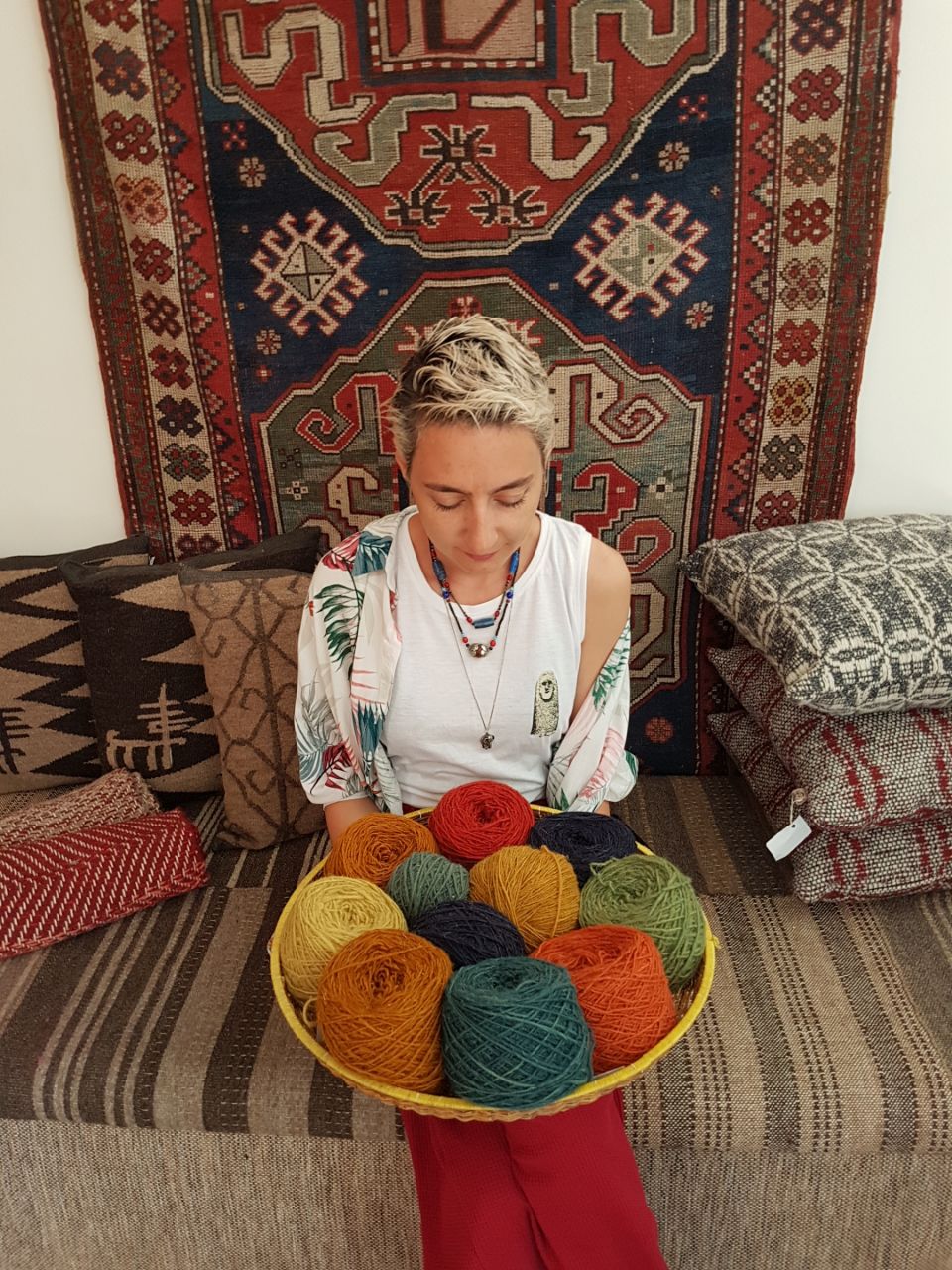
In Verishen, the women of Goris showed me the entire process from wool to carpet. It is an indescribable feeling when you take the thread in your hands and begin weaving a carpet. There is something noble in carpet weaving respect, femininity, strength, and great patience. The women working with threads are unbelievably beautiful.
I loved carpet weaving. One day, I will make it more my own.
Wool to carpet centre
Tel։ +374 77 06 06 99 Ruzanna Torozyan
FB:@wooltocarpet
The delicious part continues next, a meeting with a beekeeper. We were invited into a home, passed through the garden, and surrounded by the unusual yet pleasant “melody” of dozens of beehives.
Grandpa Grisha called me over, equipped me with a special suit, and encouraged me to walk through the garden and pick apples as I wished. In my case, “as I wished” turned into a nearly 3 kg bag by the end of the garden.
Grandpa Grisha has been engaged in beekeeping for 55 years imagine how much knowledge he has about bees. He is also a candidate of agricultural sciences and speaks with great enthusiasm about bees as well as other branches of agriculture.
Experience comes with practice. We continue to explore this time we prepare a very useful wax-based ointment, an excellent remedy for various skin problems.
The benefits of beeswax have been written about in many books and articles, so I will not overload you. I consider the beeswax experience successfully completed and am waiting for it to cool so I can take it with me.
Beeswax by Yeghevnut
Tel։ +374 94 30 93 69 Anush Malintsyan
FB:@yeghevnuthotel
What to know
To create magic, no magical wand is needed. All you have to do is visit Syunik on your free days, go through these experiences yourself, meet the “magicians” of the Syunik world, and realize how much beautiful reality exists alongside our own everyday reality.
This article was created within the framework of the “My Armenia” program, funded by the United States Agency for International Development (USAID) and implemented by the Smithsonian Institution. The content of this article is the sole responsibility of the authors and does not necessarily reflect the views of USAID, the Smithsonian Institution, or the United States Government.