Gyumri: Following the Traces of Crafts and Architecture
Did you know that the oldest mention of Gyumri can be found in Xenophon’s work “Anabasis”, or that the first Armenian theater was established and the first opera was performed in Gyumri?
Yes, Gyumri is a fascinating city in Armenia that combines a modern appearance, ancient history, and centuries-old cultural traditions. Are you still wondering what you would like to do this coming Weekend?
DISCOVER
DAY ONE
City research center
Հեռ՝ +374 94 84 44 25, Ashot Mirzoyan
FB: @CityResearchChenter
A weekend in Gyumri… a different Gyumri, with unique characteristics. For such a journey, we turn to the City Research Center NGO, which has developed exceptional urban routes.
Both during Soviet times and today, the city remains one of Armenia’s most vibrant cultural centers. It stands out for its distinctive cuisine, humor, architecture, and traditional crafts.
During the city tour, I learned that:
- The territory of Gyumri has been inhabited since ancient times. The earliest discovered and studied settlements date back to the beginning of the 3rd millennium BC.
- The first state formation created in the territory of present-day Gyumri is mentioned in a Urartian inscription from the 8th century BC, found not far from Marmashen. It refers to the area as Iridaniuni and is identified with the ancient settlement of Kumayri, located in the western part of the city, on the left bank of the Cherkez Gorge stream.
- The city has a centuries-old culture stretching from ancient times to the present day.
- Gyumri later developed significantly in the 19th century when it became part of the Russian Empire.
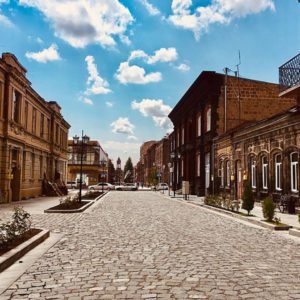
The heart of the city is the Kumayri Historic District, a historical and architectural reserve where 19th-century buildings are located. These structures represent distinctive architectural styles and a complete urban environment, including churches, museums, residential houses, and other buildings.
YOU SHOULD KNOW
In 1836, the first urban plan of Gyumri was approved. According to this plan, the city was designed in a rectangular shape, with streets intersecting both lengthwise and widthwise.
The same year, the construction of the fortress was completed. In 1837, Emperor Nicholas I visited Gyumri and founded the Russian church of Saint Alexandra inside the fortress. He also renamed Gyumri Alexandropol.
Between 1860 and 1880, houses built from red and black tuff became dominant. Thanks to the use of red tuff, building facades became more colorful. The combination of red and black tuff is unique to this period, as is the widespread use of the “Ghaytan Darz” masonry style, which involves clearly visible white joints between stones.
After the 1880s, the use of red tuff sharply declined, while masonry with white joints continued alongside finely cut stonework. This period also marked the beginning of the construction of two-story apartment buildings.
Starting from the 1890s, European (Russian) influences became noticeable. The elegant two- and three-story buildings that have survived until today were mainly constructed during this period.
At the beginning of the 20th century, many building facades were painted, giving the city a unique variety of colors. Although most painted facades were later cleaned, some buildings still preserve subtle traces of those historical colors.
Perhaps we should end the first day with only the city tour. Why? Because the information you receive while walking through the city needs time to settle. We visit the first café we come across and analyze all the new impressions over a cup of coffee.
As soon as you leave the café, filled with new knowledge, you will begin noticing important details in Gyumri that were invisible before.
WHAT TO DO
DAY TWO
In the 19th century, Alexandropol was one of the major cultural centers and was famous for its skilled craftsmen. Craftsmen were organized into separate guilds.
The origins of many family names were often connected to the craft that was the main occupation of that family. For example, Tarzyan came from the word for tailor, and Demirchyan from blacksmith.
In the South Caucasus and beyond, the blacksmiths, coppersmiths, stonecutters, masons, jewelers, carpet makers, lace makers, and even confectioners and cooks of Alexandropol were highly valued.
Many of these crafts continue to be appreciated today. Gyumri craftsmen are in high demand in Armenia, Russia, and Europe.

WHAT TO EXPECT
Gyumri — the city of crafts and arts… We discover the spirit and soul of craftsmanship through personal experience, and one of the best options is meeting local blacksmiths and, why not, creating something small from iron with your own hands.
Hovhannes’s grandson Hovhannes told me that blacksmithing was a respected craft in ancient Armenia. It was considered a profession of strong and courageous people. For Armenians, blacksmithing was a symbol of strength and power.
“Since I was a child, I have been in the workshop. My grandfather taught me to be careful while working with iron, and everything that is created must have the highest possible quality.”
The gate of the Dzitoghtsyan Museum, the chandelier of the railway station, the chandelier of the church on 58th Street, and many other works were created by this family.
Darbnots
Tel։ +374 93 531 777 Hovhannes Mnoyan
FB: @Darbnots
INTERESTING
“According to legend, Artavazd, the son of King Artashes, who was chained in the depths of Mount Ararat, was an evil spirit who could escape and destroy the world. That is why blacksmiths struck the anvil to strengthen Artavazd’s chains.
Until the end of the 19th century, folk beliefs attributed supernatural power to blacksmiths, connected with the ancient worship of metal. Since the Urartian and early Armenian periods, steel has been smelted in the territory of Armenia,” explains Gagik Martirosyan, a sixth-generation representative of the craft and holder of the title “Best Blacksmith.”
By the way, his workshop is located inside the Yerankyuni restaurant, where after the master class you can discover Gyumri’s cuisine.
We have a meal and go to meet another blacksmith.
Yerankyuni
Tel։+374 91 30 12 03, Gagik Martirosyan
FB: @Եռանկյունի-Գյումրի
“At first glance, it may sound strange, but blacksmithing is as much an art as it is a craft. You work with hot metal and must be able to create something within seconds. Iron is stubborn; it is not easy to work with,” says Garik, the grandson of Tatos, with a smile.
At the end, he assures us that in the future his son will also continue this family tradition.
This profession, passed down from generation to generation, will continue to live because it is a way of life.
Thanks to these generations of blacksmiths, the Gyumri we love today was created. Meeting them will change something inside you. From now on, you will walk through Gyumri with a wider smile, because you will personally know the masters behind the inspiring creations that make the city so special.
Kalosnikents
Tel։ Garik Papoyan, +374 93 320 643
This article was created within the framework of the “My Armenia” program, funded by the United States Agency for International Development (USAID) and implemented by the Smithsonian Institution. The content of this article is solely the responsibility of the authors and does not necessarily reflect the views of USAID, the Smithsonian Institution, or the United States Government.