A Weekend in Vayots Dzor Province: Back to the Origins
Pottery is one of the oldest crafts. It turns out that not everyone could become a professional potter, as true mastery requires many skills and hardworking hands. Each region of Armenia had its own unique characteristics and patterns in pottery. We must preserve and continue the traditions of our ancestors. Pottery is one of the main Armenian crafts that may disappear in the near future, so these skills must be passed on to the next generation.
DISCOVER
DAY ONE
Each of us should take time to touch and experience our traditional roots, so that future generations have the opportunity to feel and understand this knowledge.
I am at the Arhestanots Studio in Areni village. Arpine teaches local children and creates various clay objects. In the warmest corner of the village, she reveals the most delicate secrets of Armenian pottery.
A salt cellar placed on the table caught my attention. I learned that salt cellars symbolized Anahit, the ancient Armenian goddess of motherhood and beauty, and according to tradition, they were made by women. They represented pregnant women with open bellies, where salt was stored. Unlike other salt cellars, Armenian salt cellars can reach very large sizes. According to ethnographic records, these salt cellars were placed near the hearth of the tonratun (traditional Armenian oven house).
WHAT TO DO
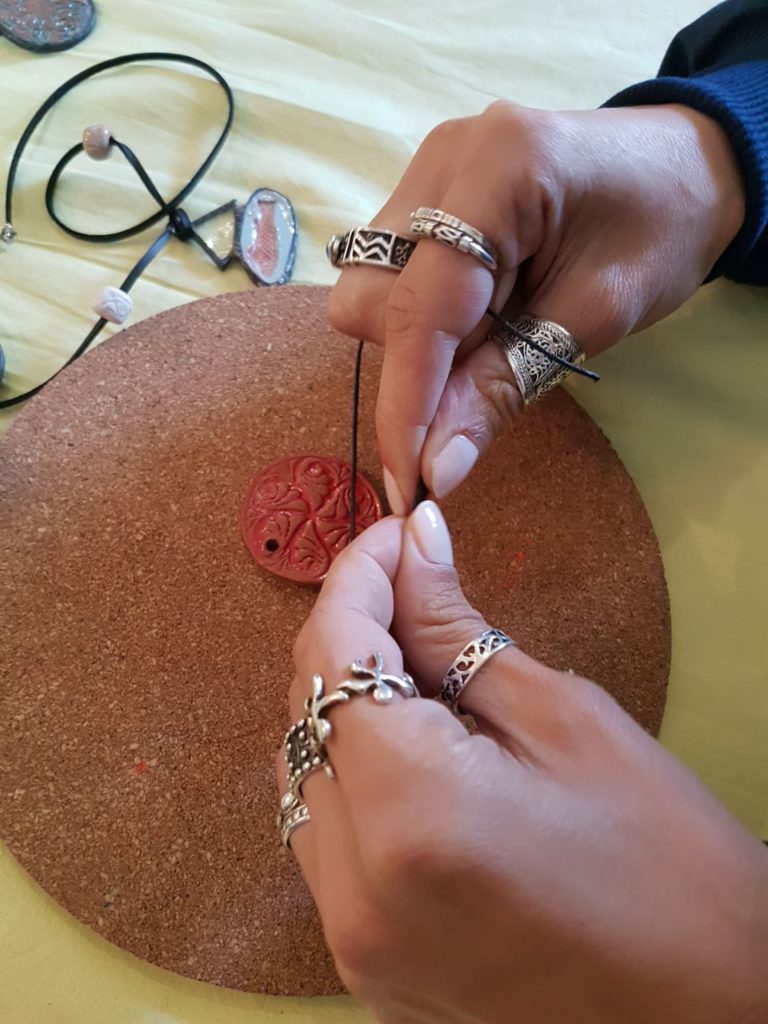
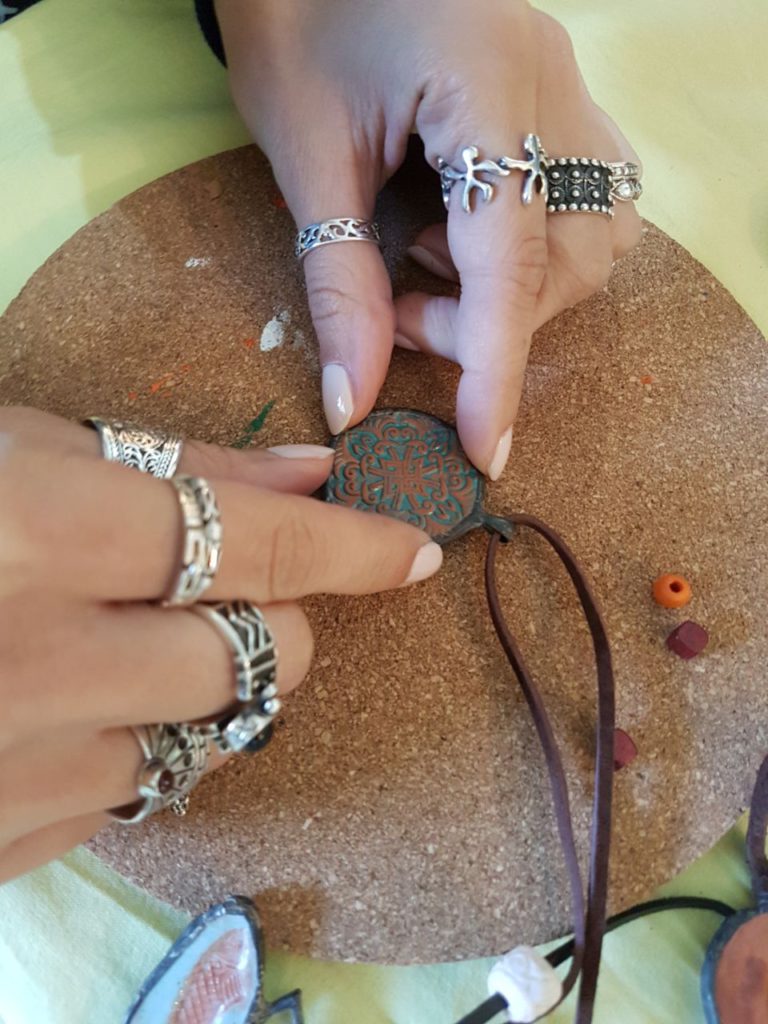
I tried to make a necklace decorated with Armenian ornaments. I discovered that these ornaments are one of the distinctive features of a culture with a history spanning thousands of years. Armenian decorative art has always been at the center of attention for both Armenian and foreign cultural researchers.
Pottery, winemaking, and the extraordinary, breathtaking nature of Vayots Dzor — what more is needed for an unforgettable weekend?
ARHESTANOTS STUDIO
Tel. +374 41 31 32 35 Arpine Matevosyan
Facebook: @ arhestanots.studio
INTERESTING
Many people know Areni thanks to its wine festival. On the first Saturday of October, people’s moods become filled with wine, their eyes shine, and their faces are full of smiles. By the end of the day, strangers become friends, a little tipsy and happy. This can only mean one thing: the Areni Wine Festival is a true celebration not only for people living in Armenia but also for visitors to the country.
A sip of wine can change your mood and create a new one. The same sip brings calmness, a feeling of strength, comfort, and a gentle smile. And sometimes one such sip can transform your entire day. Only at the end of the event do you realize that your mission that day was not only to taste wine, but also to become ambassadors of Armenian wine.
MUST VISIT
DAY TWO
Areni-1, also known as the “Birds’ Cave,” is one of the most popular tourist destinations in Vayots Dzor. Not visiting this cave means, in a way, passing by one of Armenia’s enormously rich historical treasures unnoticed.
Why visit?
- In 2010, during archaeological excavations, a 5,500-year-old shoe was discovered inside the cave. It is the oldest leather shoe ever found in the world.
- During excavations carried out in 2007 at the Areni-1 Cave in Vayots Dzor Province, scientists discovered three human skulls dating back to 4300–4000 BC, which later became the subject of research. Armenian scientists, collaborating with international colleagues and using modern technologies, reconstructed the skulls, making it possible to restore the faces and appearance of our distant ancestors.
- During the 2007 excavations, objects related to winemaking were discovered in the cave. According to Boris Gasparyan, a researcher at the Institute of Archaeology and Ethnography of the National Academy of Sciences of Armenia and the head of the archaeological excavations, the very first stage of excavations at this site brought great success because a grape press was discovered.
There had already been assumptions about its purpose, but it was necessary to prove that it was indeed an important component of a winemaking complex. The structural features — including the presence of a sloped surface typical for winemaking (where crushed grapes released juice that flowed into a special area for fermentation) and the discovery of huge clay vessels buried in the ground near the wine press — prove that this was a specialized winemaking site.
Today, this winemaking complex is considered the oldest in the world and dates back to the 4th millennium BC.
He also shared that grape seeds of the Areni variety, considered one of the ancient varieties, were discovered in the Gnishik Gorge area, not far from Areni. It is believed that grape cultivation has existed in this area for about 6,000 years, as both wild and table grape varieties have been found here.
The area will serve as an ecotourism destination, and thanks to the installed ticketing system, visitor flows will be controlled to prevent damage to the site.
ARENI 1 CAVE SCIENTIFIC – RESEARCH FOUNDATION
Tel. +374 55 51 40 08:
Facebook: AreniCave

INTERESTING
You leave the cave and cross to the opposite sidewalk. Welcome to a warm, colorful world of Armenian handmade crafts.
Everything here is so attractive that you can buy almost anything and take it home with you as a souvenir.
In this heartwarming corner, stone-carving brothers Ruben and Karen Ghazaryan will teach you how to transform stone into a delicate souvenir resembling fine embroidery or a fragile woven fabric.
The brothers draw their inspiration from Noravank, located not far from their workshop. In their khachkar carving, they use the same type of stone from which the monastery complex itself was built.
During the experience, they will tell you about both Momik and the traditional ornamental designs.
So, are you still thinking about visiting Vayots Dzor? Hurry up!
BECORE
Tel. +374 94 62 25 67, Ruben / Karen Ghazaryan
This article was created within the framework of the “My Armenia” program, funded by the United States Agency for International Development (USAID) and implemented by the Smithsonian Institution. The content of this article is solely the responsibility of the authors and does not necessarily reflect the views of USAID, the Smithsonian Institution, or the United States Government.