The Legends of Karmravor
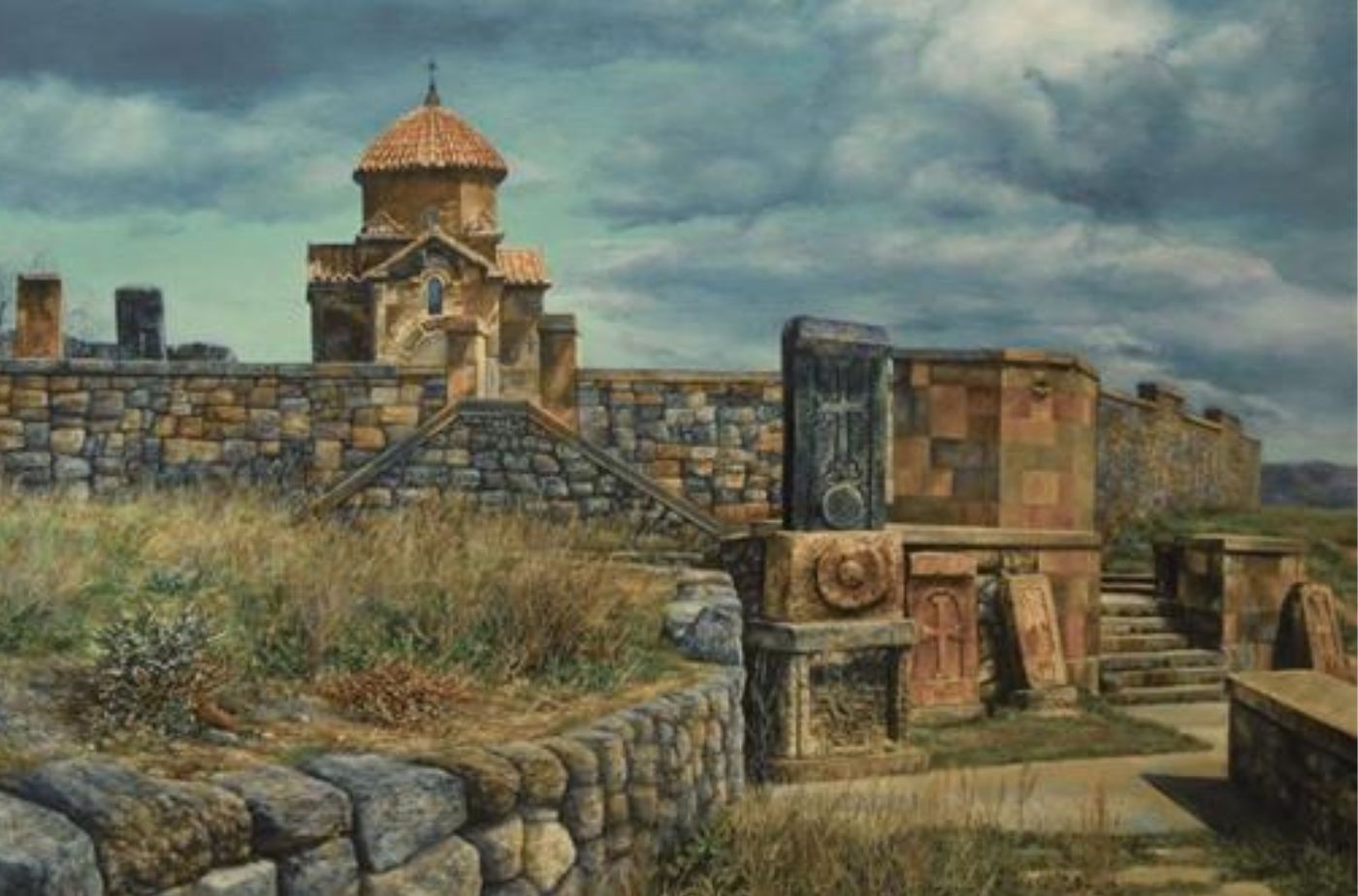
It is no secret that while traveling through Armenia, you come across places with beautiful names and beautiful stories. This journey takes us to one such place—the Karmravor Holy Mother of God Church in Ashtarak, a church surrounded by fascinating legends.
I should first mention that Ashtarak is a town with centuries of history. This is evidenced by the Bronze Age monuments, ancient settlements, burial sites, historic districts, and many other archaeological remains found throughout the area. I will certainly return here, and not just for a single day, because one day is simply not enough to explore and present everything Ashtarak has to offer. But for now, let me continue with the story of Karmravor.
According to a local legend, three sisters living in Ashtarak fell in love with a young man named Sargis. The two elder sisters decided to sacrifice themselves so that their younger sister could find happiness. Wearing apricot-colored and red dresses, they threw themselves into the deep gorge. Upon hearing the tragic news, the youngest sister, dressed in white, also leapt into the gorge, while Sargis, overwhelmed by grief, became a hermit. Later, three churches appeared on the edge of the gorge—Karmravor (Red), Tsiranavor (Apricot), and Spitakavor (White).
There is another popular explanation for the names of these churches. It is said that in one of the frescoes of Spitakavor Church, the Virgin Mary’s head covering is painted white, while in Karmravor and Tsiranavor, it is depicted in red and apricot colors respectively.
Karmravor is the only church in Armenia whose original red-tiled roof has survived to the present day. Around the church stand many remarkable Armenian cross-stones (khachkars), the most famous of which is Tsak-Kar (“The Pierced Stone”), named after the hole in its pedestal.
In ancient times, Karmravor functioned as a convent. Two remarkable relics are still preserved there today. The first is an illustrated Indian curtain that was brought from Calcutta, while the second is the Shukhonts Gospel, a handwritten Gospel manuscript donated by the Shukhyants family of Ashtarak.
Hidden in a peaceful corner beside Karmravor lies the grave of the great Armenian poet Gevorg Emin. In his autobiography My Life, he wrote that he considered Ashtarak to be “the heart of Armenia” and proudly referred to himself as “Gevorg from Ashtarak.”
The poet once said:
“The fact that today I build not bridges or canals but write books is thanks to one of the greatest Armenian writers I met during my school years—Yeghishe Charents. I am also grateful for my profession, because only exact science can help a creative person develop inner balance, avoiding unnecessary verbosity and taking ten steps where one would have been enough. Altogether, I have ten books of my own, three sons, and my little Armenia, rich in its aspirations.”
All that remains for me to add is that Armenia is truly unique. It is a land of legends, myths, folklore, ancient stories, breathtaking landscapes, and an enduring sense of mystery. Every country certainly possesses something special, but these qualities seem especially vivid in Armenia. Throughout my journeys, I will introduce you to only a small part of these extraordinary places, but know that Armenia is filled with countless legends and folk tales waiting to be discovered.
Welcome to Armenia—an Unreal Reality.